
How many doctors does it take?
A diary of illness and bewilderment

Dear Comrades, Colleagues, Neighbors, Relatives, Friends:
I’m sending out so much appreciation for all your expressions of concern for my daughter Sophie, and our family. It’s not easy to keep up correspondence in the midst of a prolonged health crisis, so I thought I would share, with her permission, some excerpts from my journal that tell the story of our struggles with her illness and the healthcare system.
Early in August our daughter Sophie began to feel poorly. After days of struggling to keep up with work and friends, she took to her bed, as they say. The months since then have spun us around and spit us out in a disorienting world of hospitals, doctors, pills, and needles, with strange customs, behaviors, and language we suddenly need to learn.
8.29.25
Sophie continues weak and with little appetite. Her fever is down, but she is having vomiting and diarrhea. We assumed it was flu, but it is lingering so long we are getting really worried.
At Sophie’s remote appointment with her PCP they said go to Urgent Care, where they found her very dehydrated and with low blood pressure. They gave her electrolyte popsicles and said we should give her 4 oz of electrolytes every two hours, including waking her at night.
That’s a struggle. Even though her mouth is very dry she can’t seem to drink more than a few sips at a time.
It doesn’t help that the kitty always jumps up on Sophie’s bedside table and drinks her water, then knocks over the cup. Today I bought her (Sophie) a metal cup with a lid and straw.
8.31.25
We have tried to help her hydrate, but it’s hard. Her mouth is so dry I can hear it, but is getting a few sips into her worth disturbing her sleep every two hours? She is so tired. Plus, she has night sweats that disrupt her sleep, and I suppose also make her more dehydrated. This has to be something more than flu. It reminds me that when I got Lyme’s Disease my doctor insisted it was flu…
Sophie is weak but she’s is a trooper. Always gets up for meals, but it’s so frustrating because she can only eat a few bites.
Yesterday morning Brian came home saying he had just seen a couple neighbors in front of the elementary school on 34th being dragged away by masked men.
I am part of a neighborhood Rapid Response team so I walked down there to see if I could help. I found the family out in the yard, along with neighbors, all distraught. ICE had just invaded their yard when the father was mowing the lawn. They grabbed him and another neighbor, and chased a third, who managed to escape.
While they were dragging him away the father yelled that he had documents from his immigration process, but they would not let him get them. They just stuffed him and the other man into an unmarked vehicle with tinted windows and drove away.
His wife and three small children are US citizens, all born in the US. We tried calling various hotlines but didn’t have much luck on this holiday weekend. The ICE abductors come out on holidays when folks will be outside, unsuspecting, having fun.
We drove to a nearby immigration center but got no info other than more numbers to call. “Find my phone” indicated he was in Chantilly, Virginia, and the family was discussing going there. I told them I couldn’t go because my daughter was sick.
We were still in the car when he phoned. After some nerve-wracking moments while the wife and brother fumbled to install the prison phone app on her mobile, they were able to talk with him for about 10 minutes. He reassured them he was okay, but had found out that no detainee would get to see anyone until Tuesday.
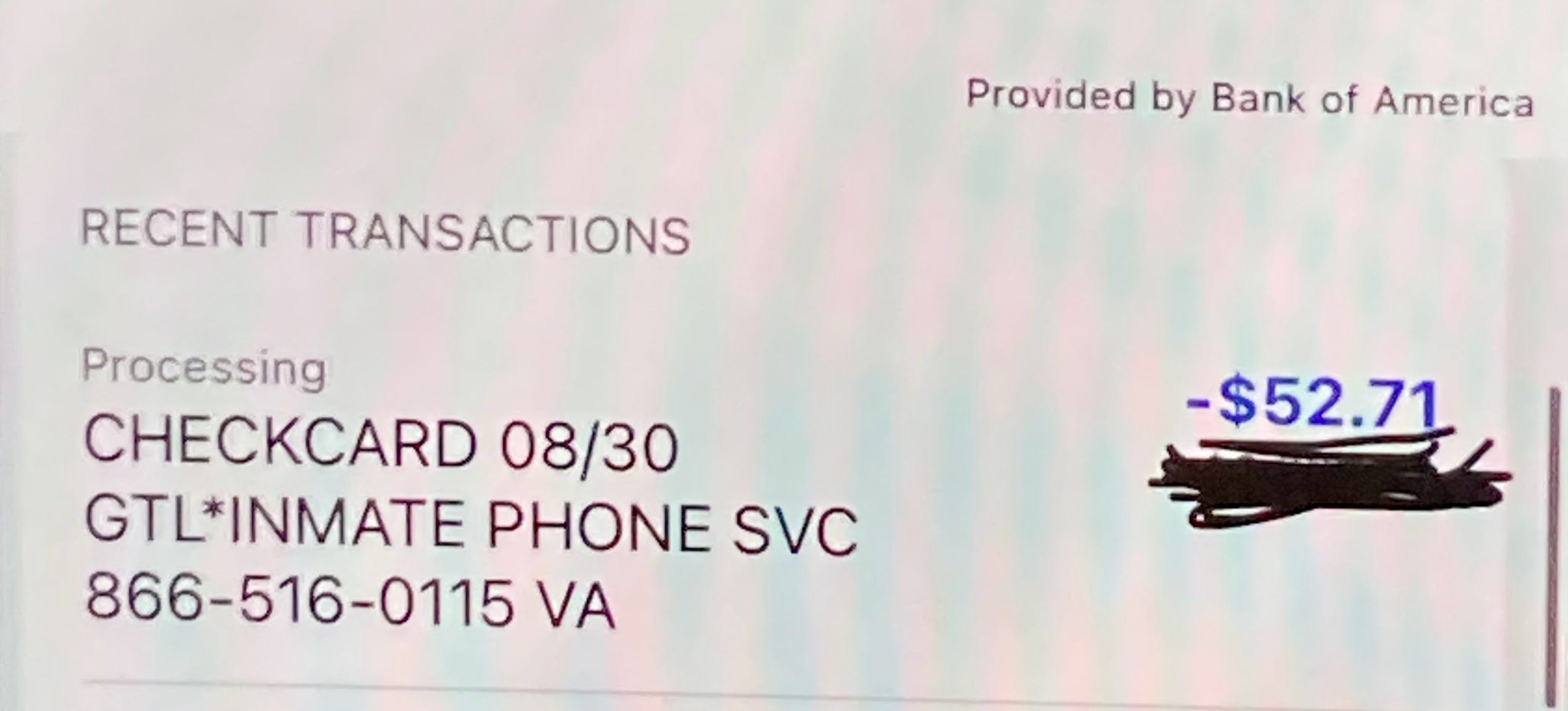
After the call ended, the app texted her a receipt. The charge was $52.71! Yes, you read that right—that’s what the prison and Bank of American gouged her for.
The whole thing is horrible, but somehow that criminal overcharge is what got me the most.
The wife was stoic, but I could see she was struggling to hold it together. They had planned a family picnic and birthday party for their youngest. Instead…
9.1.25
We’ve kept up Sophie’s rehydration routine as well as we could for two days, but she is just getting weaker. It’s clear we won’t won’t be joining the family Labor Day picnic today. We’re taking her back to Urgent Care.
9.2.25
Her blood pressure was so low they sent us straight to the Emergency Room at Washington Hospital Center.
In the ER they took her vitals and started her on fluids right away.
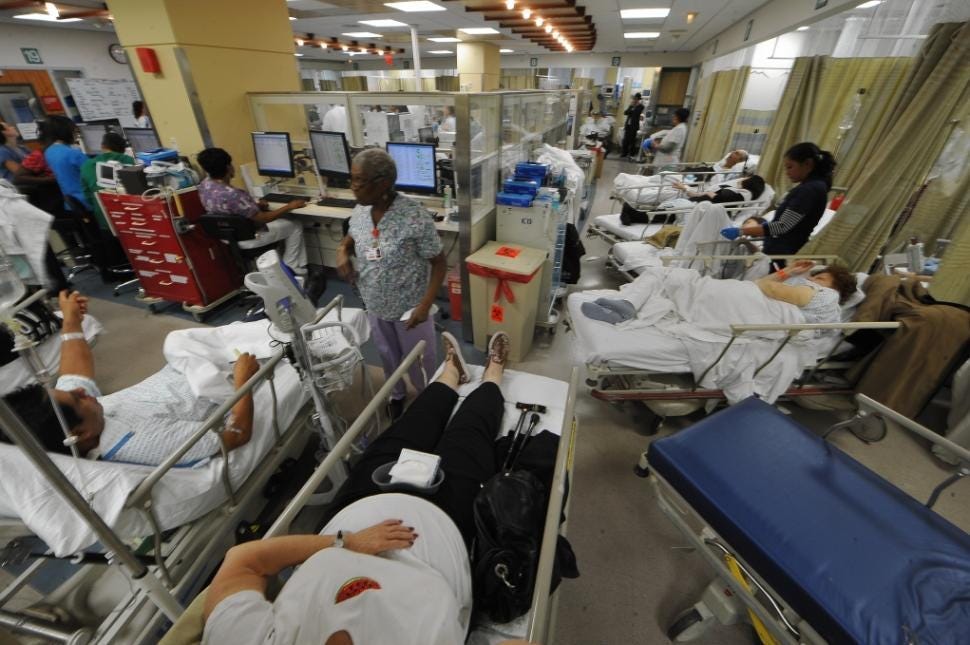
Her stretcher is out in the main bay, cheek by jowl with dozens of other sick and hurt people also on stretchers, Everywhere are machines beeping, police bringing in injured handcuffed prisoners, loud arguments, people crying or yelling. Plus the other patients’ conversations, moans, and chatter from their various devices as they try to distract themselves.
Despite acute gastric issues, Soph has to thread her way through all that chaos to get to the public bathroom, hooked up to a wheeled pole with the IV, helped by me, Brian, or an orderly if one is to be had.
There’s barely any room for me to perch on the end of her cot. I have to get up each time personnel in scrubs squeeze by with equipment or another stretcher. And this is merely Labor Day weekend, not a flood or earthquake, let alone a bombing. I can’t even imagine what that would be like; rather, I don’t want to imagine it.
9.3.25
Today Wednesday in the wee hours they finally admitted her to a hospital room, after 32 hours in Emergency. They brought in a recliner for me to sleep beside her.
9.5.25
They have kept her on fluids and she seems a bit better, though still hardly eating. They are doing a million blood tests—taking her blood several times a day. The rationale is different, I presume, but this constant bleeding reminds me of old-time doctors bleeding patients with leeches.
Soph calls the phlebotomists vampires. They take dozens of vials of her blood, and always seem to come in when she’s trying to eat or sleep.
She’s also had EKGs and X-rays. And a bone marrow biopsy. That was scary!! All I could do was stand there and hold her hand while the doctor bored a hole into her back. She was very brave.
That was the most worrying test, but thankfully, the results—which just came back--showed no leukemia or lymphoma or other cancer of the blood or bone marrow. Phew!
But they seem no closer to finding out what she does have…
9.6.25
There is so much that is confusing! I ask about whether we (Brian and I) should wear masks. They say things like “probably not.” Yet all the medical personnel are putting on special caps, gowns, and gloves every time they come into the room, and trashing them when they leave. I can’t tell if it’s to protect Sophie from them, or if they think she is contagious herself. After a while, they decided it wasn’t necessary and stopped doing that.
I finally got a more enlightening answer: they don’t want to bring in any contagion from other patients. Great, but don’t they think we could also do the same? So sometimes I wear a mask and sometimes not. I feel so dense because after all these days I still can’t seem to get clarity.
She still has low blood counts. At 6 AM (well before I got there) they came in to propose giving her a blood transfusion. They asked her to sign a waiver. The waiver was scary, she told me, and she was not convinced by the reasons they gave. She remembered her dad saying that when her grandfather got a transfusion, they had made a careful search for the blood to use, because it was very important it be exactly right. So she didn’t sign it.
When I arrived I thought her choice was reasonable, and so did my sister Beth, the doctor.
I don’t think it’s right that they ask her to make decisions like this on her own—not because she lacks intelligence, but because it’s too hard to make important health decisions for oneself, even when not weary and ill. You need someone on your side to help you think about this. And if they didn’t insist or explain farther, I guess the whole thing was optional?
I know that sounds like the doctors are not on her side. Which isn’t true. Except it sort of is, in some kind of way I can’t put my finger on; not because they are against her, of course, but because they seem to have different ways of thinking.
I swear, I feel so dense because after all these days there is still so much I can’t understand.
9.7.25
I stay with Soph much of the day, sitting in the room with her, or sometimes going down to the patio to make calls and send texts related to an event I’m organizing on imperialism and solidarity with Venezuela. It’s happening next week (scheduled prior to Soph getting sick). I also make calls to hand off to others in our group the ICE detainee support I was doing. Brian comes in the afternoon after work.
Sometimes I leave and return, as I did to go to the memorial of an old comrade, Nkenge Touré.
I’ve spent a couple of nights in the recliner they put in there for me, but hospital policy does not encourage relatives to stay the night, or even to be there at all past 8 PM or before 9 AM. Which is frustrating because the doctors make their rounds early, coming to her bedside to ask questions and impart information about her condition and what they’re doing.
Even in the bloom of health Soph is not a morning person. Hence, when I or her dad get to the hospital she can’t convey much of what they told her. She is weak, tired, out of it. Fortunately, the nurses are pretty good about tracking down doctors to talk to us again.
Yet even though the docs try sincerely to explain what’s happening, it is difficult to understand the lingo and the abbreviations, even with the help of my sister and mother, both doctors, who have been on the phone with us often.
The doctors continually ask Soph the same questions, especially about animals she handles on the job (she works in a pet grooming place) and whether they scratch her or have ticks, plus a bunch of other things like if she smokes and drinks. All these doctors from different teams—infectious disease, internal medicine, hematology—ask the same questions. Do they talk to each other? “I’m going to write down the answers and just hand them out when they come,” she jokes. But she doesn’t; she’s too tired.
Yet she is definitely feeling better. They have given her lots of IV fluids so her dehydration and blood pressure have improved. She can get out of bed more easily. She is off constant monitoring. That’s progress, at least.
They started her on the antibiotic doxycycline, on the theory it will help if she has a tick-borne infection. But she does not think she’s been bitten by a tick. Doxycycline worked great for me when I had Lyme’s, which is a tick-borne infection, but will work for her?
9.8.25
Early this morning Sophie told me by phone that last night they gave her intravenous doxycycline and it hurt like hell. Sophie begged them to unhook it, but the nurse refused, making Soph endure the drip until it was finished.
I was furious. If the intravenous application hurts so much, why didn’t they give it to her orally? She’d had a hard time with the large pill the day before, when they started the medication, but clearly the IV was much worse. They could have split the pill to make it easier to take. The medication wasn’t critical or life-saving, and she was obviously in her right mind. It made my blood boil to think of her helpless and in pain, and the nurse deaf to her plea.
More importantly, she asked them to stop and that’s what they should have done! I just looked this up and found that among patients’ rights is “the right to fully participate in all healthcare decisions, including the right to refuse treatment.”
Sophie then told me that early this morning, before I arrived (they only let visitors in after 9 AM), they came to give her the next IV dose and she adamantly refused. Good for her!! The nurse called one of the doctors in, who said to go back to the pill form of the medicine.
It’s ironic: my doctor wouldn’t listen when I said I had Lyme’s Disease, even though I’d had a known tick bite which produced a rash. After months of illness and my own research to find out what was the matter, I chose another doctor, marched into their office, said I had Lyme’s and demanded doxycycline. Once I started taking it, I began to get better immediately, though it took two years and four courses of it to finally get over the illness, which left me with a chronic heart condition.)
For Soph, though, doxycicline is proving to be a nightmare. I understand they’re doing the best they can, but the truth is they don’t even know if that’s the correct diagnosis or treatment.
9.10.25
She’s still in hospital. I’m working on organizing the Venezuela solidarity event while sitting by her bed. Her blood counts are somewhat better, but she is still barely eating. I have never yet gone down to the hospital cafeteria because she eats so little of the (usually enormous) meals that there is plenty for me to nibble on after she’s done.
9.11.25
We’re home! Yesterday evening, they suddenly pushed us out. Excuse me, discharged her, though it felt like they simply threw up their hands. Maybe they were satisfied she has an infection that doxycycline will cure, but the whole process felt rushed and perplexing.
They told us to follow up but didn’t tell us how or where. After we were told about the discharge a social worker looked into Sophie’s room briefly to ask if we needed anything (kind of late in the game, I’d say). We said she doesn’t really have a primary care physician, because of Medicaid being such a difficult tangle to navigate, nor a way to make appointments with the specialists they said we needed to follow up with. The social worker said she would find out, but when we left the hospital later that evening we still hadn’t gotten any further information.
It’s good to have her back home, where she can sleep through the night and not have people constantly taking her blood. But she is still not well, and we still don’t know why.
Reflections
I think doctors and the whole medical structure underestimate how hard it is for patients and relatives to understand the words, let alone the implications, of the information they are imparting.
Is there a course called “Communicating with Patients: how to gauge whether people have truly grasped the meaning of what you are telling them and know what to do next?” There should be.
Some people say that the healthcare system doesn’t care about us. I think it’s more complex than that. It’s true at the corporate level, where the goal is making money or at least staying afloat financially. But from what I have seen, most of the on-the-ground personnel really do care about their patients.
Yet they seem disconnected, even though they work in teams, and the different teams work with each other. Later in this saga we would realize the extent of the disconnection, with the doctors not seeing past lab results that could have put them onto the correct path for diagnosing her weeks earlier.
The issue is not whether doctors care as individuals or whether they speak clearly or kindly. That’s important, of course, but most of those we met at that hospital do so. The problem distance and disconnect is not a matter of individual behavior or protocols. Even though I asked questions constantly, and they answered the questions willingly, the fragmented way things are presented makes it very difficult to get a good picture of what’s happening.
Hospitals are incredibly complex systems with all kinds of rules, customs, hierarchies, and conventions. Trying to navigate a complex illness within one of these systems, which I surmise is a hologram for the system as a whole, is a major challenge. I was not prepared for it; I barely realized it was its own challenge, distinct from all the other challenges we face as patients and patient advocates. It is hard to even name or define this challenge—it sort of surrounds you.
An example is the above-mentioned patient’s right to information, participation in decisions, and ability to refuse treatment. If doctors have poured out information over a patient lying half asleep at 7 am, or if we have been given 10 pages of information at 8 pm as we’re being sent home, exhausted and discombobulated, with no one checking to make sure we have truly understood, does that fulfill the right to information?
If we have incomplete understanding, and yet are asked to make an important decision, such as whether to have a transfusion, does this make sense?
I would love to know who has had similar, or different, experiences of trying to gain understanding of a complex health problem facing you or a loved one. Did they help you get a clear picture of what was happening? Did you leave with the means and information to follow up with doctors appointments and also to care for your person after discharge from the hospital?
Kitty Kapers
In the midst of pain—personal and family pain, the pain of my neighbors hunted by ICE, of bombs falling in Gaza, devastation in Sudan, and so much more pain in the world—it is good to have something that forces me to stay in the here and now.
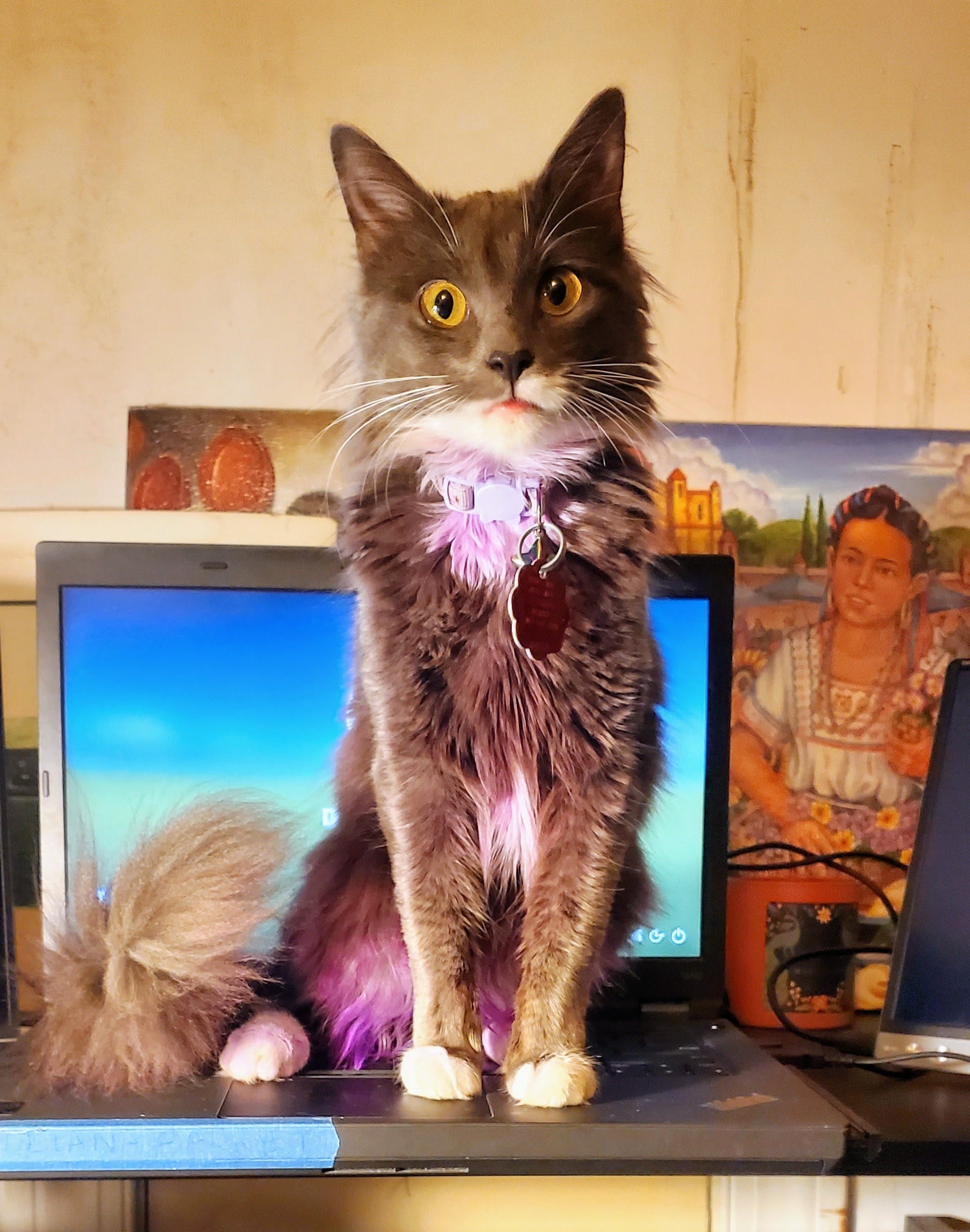
At this moment, for me, that is our little cat Stormi. She is something of a hellcat, tearing around the house, jumping onto the counters, knocking things off for the pleasure of seeing and hearing them fall. She particularly loves doing this with medicine bottles, of which there are many nowadays, though she’ll also push over a mug (after pawsing to drink out of it) to enjoy the crash.
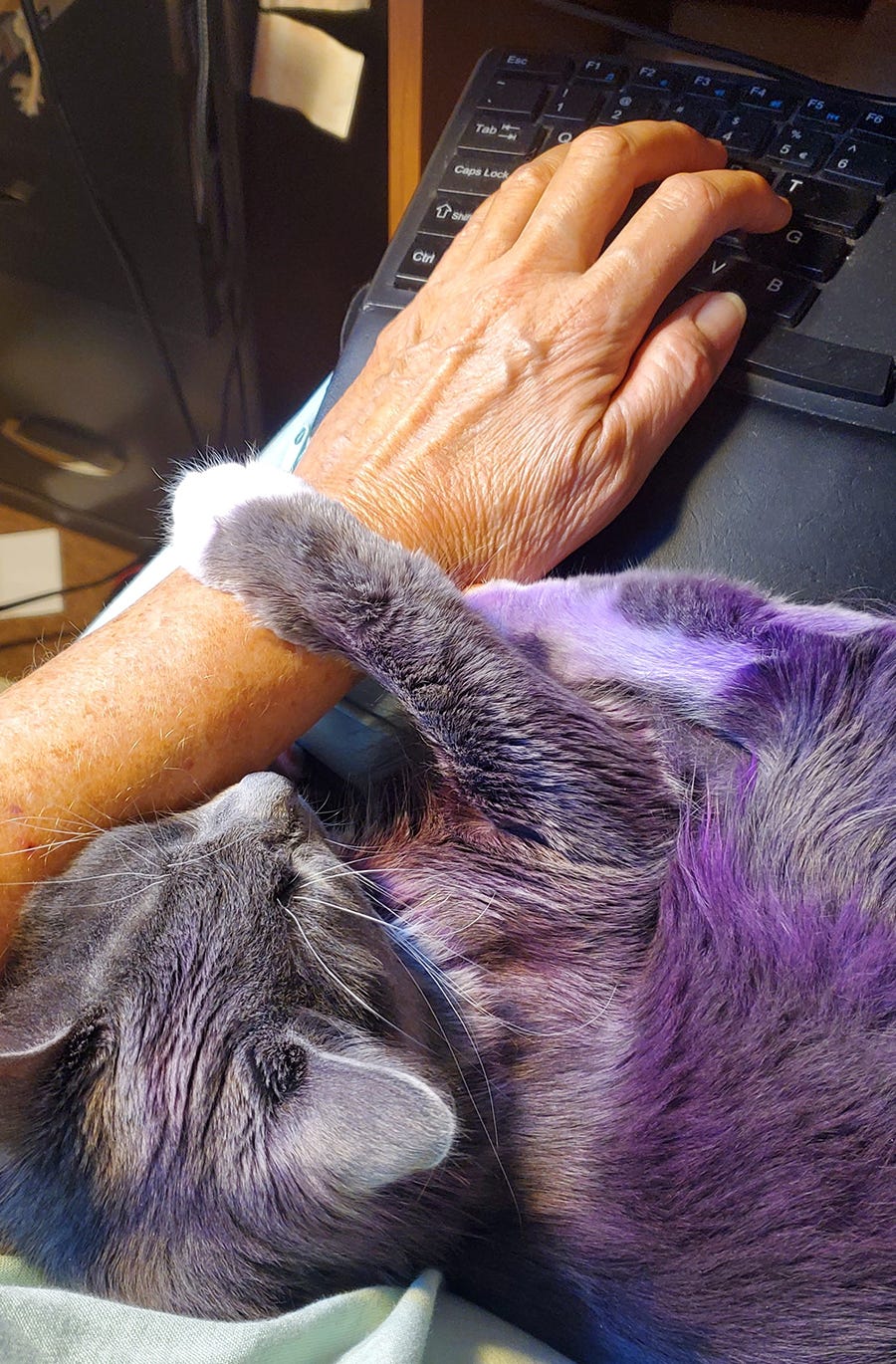
Yet she is sweet and snuggly when she wants to be. She curls up in my lap while I’m writing for a few peaceful minutes in the early morning, before the Jeckyl-Hyde transformation hits and she suddenly bites my hand, pounces on the keyboard, chews on the cords, knocks over the mouse…
This is pretty typical when things are murky. In oncology we have tumor boards to bring specialists together to discuss complex cases but unfortunately this does not happen in cases like this, maybe this is an area for medical reform rather than punting one out the door. Insurance demands about no longer covering a case are intense in hospitals with their case management teams. Still, no excuses for this situation.
Hi Juliana, Brian, and Sophie, this experience resonated for me in many ways, the fear, pain, and cluelessness. I was 14 when I developed mysterious pain, 35 pound weight loss and other symptoms. My Dad was a doctor and got me admitted to NIH for 3 months. I was on the cystic fibrosis floor where the little patient roommates constantly died. The tests and treatments hurt. I called home every time i needed an IV. Eventually with super high doses of steroids, I recovered and had many surgeries and a long healthy remission. My family and classmates were so supportive even electing me to SGA and cheerleading (can you believe that?) It's important to recognize how this impacts the family, especially sibs who are neglected, I wish Sophie and the fam more ups than downs!
I admire you, Juliana, for juggling home and politics.